
Ballingarry and the Famine, 1845-1850. [6 March 2026]
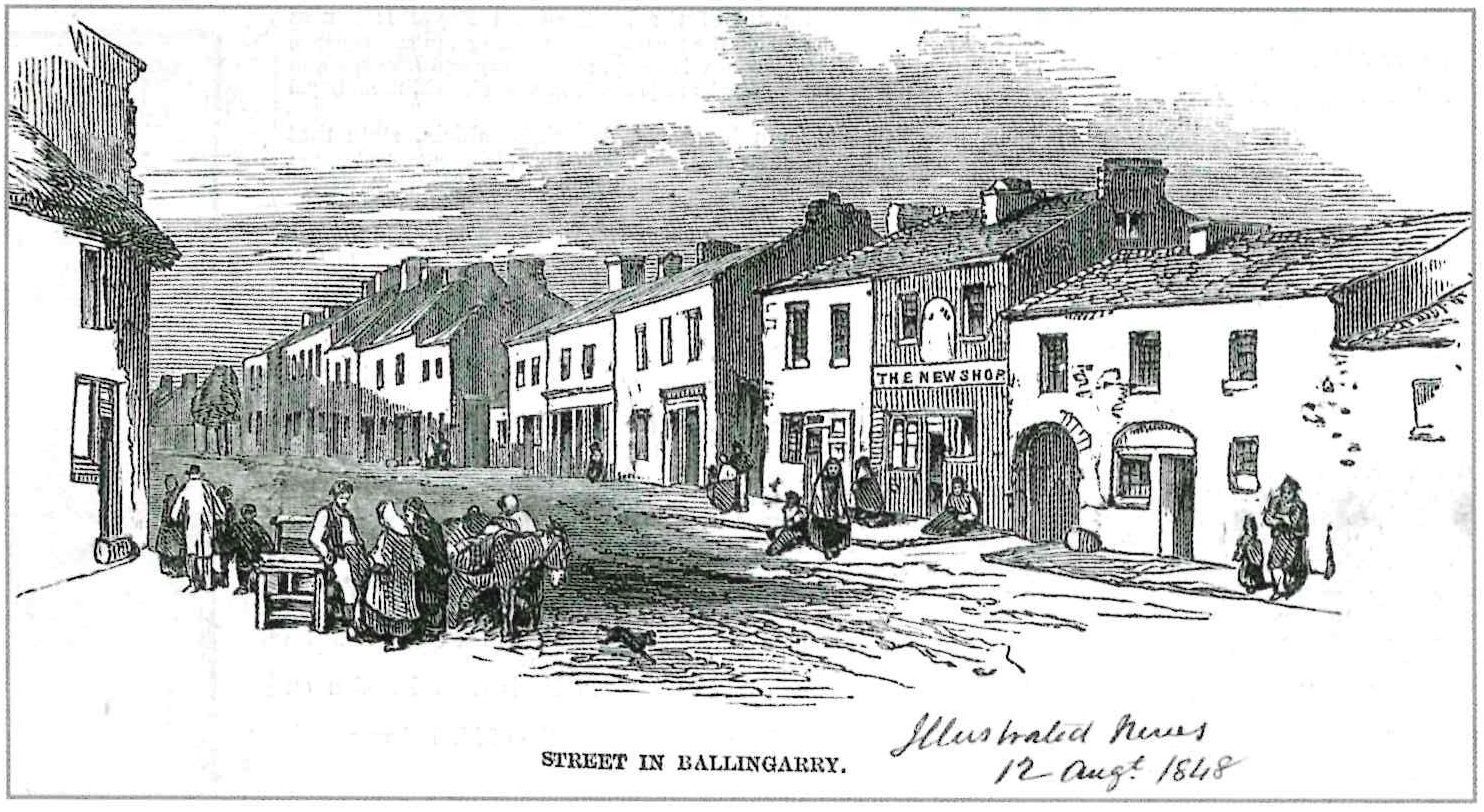
In the Great Famine of 1845-1850, one million Irish people died and one million fled the country as refugees. In the House of Commons in London, the leader of Young Ireland, William Smith O’Brien was the most forceful critic of the government’s famine policy. Ballingarry has a tradition of agriculture and mining (the mines closed in the 1970s). The parish suffered severely during the famine. When the Famine began a Relief Committee was established with the Rev Garret Wall of the Church of Ireland as chairman and the Catholic priest Fr Philip Fitzgerald as secretary. See his Report below. Money raised was spent on the purchase of Indian meal. As the crisis deepened the mines ceased production because there was no demand for coal. The population became destitute. So many people were dying that Fr Fitzgerald feared there would be ‘heaps of unburied dead’. In May 1847 a soup kitchen was set up. By mid-1847, 5,698 people in Ballingarry were in receipt of soup rations. In August 1847 the government closed down the soup kitchen scheme.
Ballingarry was the most impoverished parish within the Callan Poor Law Union. The Workhouse for the Union was situated in Callan, Co Kilkenny. It was established to accommodate 600 paupers. As late as 1851 it had 2,102 inmates. Between 1845 and
1851, 3,515 people died in Callan Workhouse and in its adjoining ‘fever sheds’. An Auxiliary Workhouse with 67 beds and a separate Fever Hospital were set up in Ballingarry. Thirty five patients in the Fever Hospital died in one week in December
1847. Coffins were supplied at ten pence per foot. In Farranrory Upper, the townland where Famine Warhouse 1848 is situated there were 104 people in 1841, but only 56 in 1851. Almost half the population had disappeared. These people died or if they were lucky they managed to flee Ireland. The Mc Cormack family left for the United States in 1851. In the period 1850-1855 another million Irish people emigrated.
In the census of 1841 the population of Ballingarry was 7, 062. In the census of 1851 the population had reduced to 5, 134 people, a loss of 1, 928 people. The Barony of Slieveardagh lost 9, 805 people in that decade. The loss in County Tipperary was 103,986, a 23.88% decline. The percentage decline in Co Kilkenny was 21.56%. All parts of Ireland, to a greater or lesser extent, were affected by the Famine. However, the one million victims who died are overwhelmingly anonymous. During the later stages of the Famine it is estimated that landlords evicted 500,000 people from their estates. In 1850, twenty landlords owned all the land of Ballingarry. Seventeen of these were absentees.
The evictions on the estate of the Earl of Desart in Ballingarry
contributed to the foundation of the Callan Tenant Protection Society which was an important forerunner of the Land League of Michael Davitt and Charles Stewart Parnell. In June 1850 it was reported of the evicted townlands that ‘In Ballintaggart, the multitude of the tenantry are in great distress… Knockulty presents one scene of unmitigated unexampled misery, where all, without exception are suffering the horror of extreme destitution…The ordinary fences along the road and thro’ the fields at Knockulty, consisted too often of bedsteads and the fragments of broken furniture.’
An annual Famine 1848 walk takes place to Famine Warhouse 1848 on the last Saturday in July as an act of witness and remembrance of all those who suffered and died locally and nationally during this catastrophic period in Irish history.
By Dr Thomas Mc Grath, historian.
Famine in Ballingarry, South Tipperary by Fr Philip Fitzgerald.
Report by Fr Philip Fitzgerald, Catholic Curate to the National Repeal Association in Dublin published in Tipperary Free Press on 8 May 1847.
‘… Speaking of adults, the deaths at ordinary times would average ten each month, though since last October [1846] the increase was constant it was comparatively slow until February [1847] when they amounted to about twice this number. After this when those on the public works were attacked with dysentery – the effects of cold and want – the mortality amongst them became much greater. But at the present time, that to this wasting and widespread disease, fever, unusually malignant and fatal is superadded, the deaths far exceed anything remembered by the oldest persons living. If anyone entertain a doubt of what I have stated, the scenes of wretchedness and desolation which every where meet the eye, will soon convince him of the truth – funerals passing and re-passing in every direction – the congregations on Sunday reduced by half – the churchyards like fields lately tilled, without a green spot, constantly visited by processions of a few gaunt figures, carrying with difficulty the remains of some more fortunate relative or friend, themselves not less pale and ghastly, and scarce sufficient in strength and numbers to make the grave. From the sad effects of this calamity all classes have suffered severely, but most of all those on the public works, and especially the old and decrepit of both sexes, who were exposed without food or clothing to the piercing cold of winter. Indeed almost all of these are dead. Being secretary to the late committee of the district, I had a good opportunity of witnessing the dreadful effects of the system under the labour act on these poor creatures, and could at this moment, refer to the cases of many who attended the committees for weeks before they could be admitted on the books, and when admitted died a few days after, having scarcely time to earn for themselves the price of a coffin. But to know the accumulation of misery that presses them to the earth, it is not sufficient to witness the pale cheek and the haggard look, nor the emaciated and squalid appearance of these persons...
To have a thorough knowledge of their wretchedness you must enter into their cabin, and observe the condition in which they live. Here indeed with collieries worked amongst us, the poor, were better circumstanced than in many other places, their employment and consequently their resources were greater. Accordingly the houses were neatly furnished, and if without ornament they contained at least the accommodation necessary for daily use. Now the interior presents a different spectacle, for there is nothing to be found there but the bare walls – neither tables, nor chairs, nor bed – all are either pawned or sold; so that it is easier to imagine than describe how human creatures can live within them. How is it possible to endure such a state of things for any length of time is to me inconceivable; but of this I am certain that no stable could afford a worse lodging and that the beasts of the field are better housed and fed than the people generally through the collieries.
During the last three months I have often attended whole families of whom some were dead and others dying, stretched on the damp ground with hardly as much straw as covered where they lay, having neither food or drink besides cold water to allay the burning heat of sickness longer – they are pest houses of contagion and famine, and more receptacles of the dead than dwelling places of the living. That such persons could at all think of cultivation is what no reasonable being could expect. Their holdings indeed are very small, but in them there is not sown even a cabbage plant, nor is there amongst them the smallest preparation making for the next year to prevent the recurrence of a similar calamity.
On yesterday, all, without exception, were dismissed from the public works and over one thousand more cast upon the world without one pennyworth to live on, as the new committee has not as yet done anything – not distributed a single ration to the starved multitude who have been for weeks waiting on them. This is not indeed the fault of the committee, but of the obstacles thrown in their way and the annoyances to which they are subjected. So that I greatly fear that the past, bad as it has been, is only the beginning of sorrows – for let there be another week of the same kind and we must have heaps of unburied dead. This district will be one vast grave yard, and afford a most beautiful illustration of the blessed effects of political economy.’